Showing posts with label MoMA. Show all posts

Friday, January 23, 2015

Art Bomb-1/23/2015 Clare Johnson. Henri Matisse

Aleathia says:

Originally I was going to try and profile artists from all the states in a sort of alphabetical order, but that really isn't my gig so I am going to try and hit all the states that I have lived in first and see how it goes.

One of the most influential times in my life, when I found out who I really was, happened in Seattle. It is the classic small town girl goes to big city story.  I had some of the best times of my life there, but in the end came back to the state of my youth to grow my roots.  Seattle was a beautiful garden of art and music and writing.  There was so much to do and see there.  It was hard to cover it all.  Having said that, today's artist is Clare Johnson from Seattle, Washington.


Clare Johnson is from Seattle, WA but obtained her education in many places including Brown University and in London at both the Slade School of Fine Arts and Central St. Martin's College of Art and Design.

Her ink drawings are painstakingly detailed, intricate, and intimate.  They are said to obsessively deal with the lines between solitude and loneliness; the lines between comfort and disconsolation.


This project started as nightly drawings on post-it notes before going to bed and blossomed into a fine collection of black and white snapshots of simple, but eye catching scenes.


Johnson's paintings are usually exhibited on stretched, unframed canvases to confirm to the viewer that something is always missing.


John Says:


I go and see a lot of art. Yet I don’t really know how to write or talk about it. I see these people in galleries or in museums standing in front of the paintings and dissecting them to the point of ridiculousness. At times it’s reached a point where I wonder if these people have come to the museum to look at a van Gogh or an Andre Derain because they like the art, or because they want to hear themselves pontificate on yet another idea that they’ve gotten wrong. I guess these blowhards beat the people who walk up to a painting, snap a photo, and then walk away. To these morons seeing great art is akin to standing in front of a big, famous building, or photographing their shitty lunch. The works of the masters have become yet another notch on their social networking belt.

Anyway since October the MoMA has been putting on a huge retrospective of Henri Matisse’s Cut-Outs. If I may lift or paraphrase from the MoMA’s web site, the Cut-Outs were a series of works that Matisse began doing in the late 1940s once he got too old and senile to paint regular paintings. Essentially the Cut-Outs (should I be capitalizing this?) are painted pieces of paper cut-out in order to form shapes or designs, or in some instances like this one (a personal favorite) made as prep work for a stained glass window:


Matisse used his cut-out scheme for his print book Jazz (1947):


His cut-out work was also featured on the cover of several issues of the French art magazine Verve
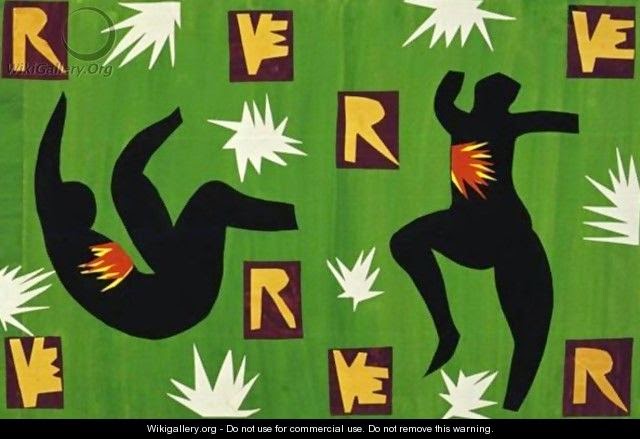

Good ol’ Henri even decorated his dining room in his apartment with cut-outs, this one being his famous and not often seen The Swimming Pool:


And who could forget Henri's famous Blue Nudes:


I’m not going to begrudge Matisse his art. No one is above criticism but maybe a guy who gave Picasso a run for his money back in the day gets a pass. Or maybe not. That is to say I was pretty unimpressed by the Matisse Cut-out exhibit. There were over 100 works in the thing (again, I’m pillaging the MoMA web site), and I spent a good hour in there only to walk out and look at my wife and shrug.  I had a much better time looking at the Toulouse-Lautrec and Jean Dubuffet exhibits. It’s hard to admire something that I could do on my own, or even sit down and watch my soon-to-be five year old niece do….although she’s a pretty keen artists. Even psychiatrists get her. I’ve always been more impressed by something like this:


But what do I know? The exhibit is beyond popular right now. You need an appointed time to go in and view it, and then really it’s simply being overwhelmed by the amount of cut-outs hanging on the walls, the crowds trying to talk art, kids bitching about being hungry, teens sitting on the floor texting their friends, or bitching to the guards about how they aren’t allowed to take selfies with the art.

Matisse: The Cut-Outs runs at the MoMA until February 10, 2015


Friday, August 15, 2014

Art Bomb-8/15/2014 MoMA Etiquette, Graffitti


john says,
While there is a lot to be written about art, I’d like to take a little bit of time to write about art museum etiquette.  Art museum etiquette in America is practically dead from my point of view.  It used to be that one went into an art museum and experienced the same quiet reverence that was given to lesser places like religious establishments.  This is no longer the case.  Now walking into an art museum is like walking into controlled chaos or a street fair.

Cell Phones and Tablets: Cell Phones and Tablets should be banished from art museums.  I never remember being allowed to take pictures of the art.  But because of the prevalence of these digital infestations museums have given up and slackened their rules.  They’ve allowed for “non-flash” photos to be taken.  Instead of being able to stand in front of Vincent’s van Gogh’s Starry Night or Picasso’s Three Musicians in quiet contemplation, I am now surrounded by dozens of people posing for selfies in front of a work of art.  And don’t even get me started on these kinds of assholes….


SILENCE:  When in the hell did the art museum become a mall?  Cell phone chatter.  Tourists shouting.  Know-it-alls loudly expounded on the history and meaning of each piece of art.  You aren’t a docent Mr. Art Genius, so shut the fuck up.  Kids crying!  I try and try to understand people with children.  But if you’ve taken the time and spent the money to see a Modigliani, why in the hell would you take a screaming and wailing three year-old with you?  You’re just ruining your own experience and the experience of those around you.  Go to the zoo instead.

Bored Kids and Pushy Parents:  Don’t bring older children/teens into an art museum if they don’t want to see art.  There’s nothing worse than walking around an art museum and having to hurdle bored tweens pressed against the wall playing on their cell phones, or dodging a standing teen updating their Facebook status about how much this sucks.  And you pushy parents: maybe it should be enough that you got your kid to acquiesce to the art museum.  But stop interrogating the poor bastard.  Excited mother: And Joeys what painting is this?  Joey (bored tone): Christina’s World.  Mom: And who painted it?  Joey: Andrew Wyeth.  Mom: And what year did he paint it?  Joey:  I don’t know.  Mom:  Joey, I thought we went over this at home.  Joey (shrugging, walking away).  It’s Saturday……leave the kid be.  Let him discover art on his own instead of instantly making him hate it (and you) with this Spanish Inquisition.

Well…I’ve gone on for too long.  Overall, going to an art museum can be an enriching and enlightening experience.  Let’s just get back to a modicum of respect while we’re walking around with the masters.  Right now in NYC at the MoMA there is a fantastic exhibit on the prints of Henri de Toulouse-Lautrec that is a must see….provided you can get Randy Newman’s Short People out of your head while you’re walking around it.


Ally says:


“The greatest crimes in the world are not committed by people breaking the rules but by people following the rules. It's people who follow orders that drop bombs and massacre villages.” 
― BanksyWall and Piece
I’ve always been a fan of street art. Both living in NYC and traveling in Europe I’ve gotten to see my fair share of it:

Sunset Park Brooklyn 40's 


Sunset Park, Brooklyn 40's

South Slope, Brooklyn 18th 


South Slope Brooklyn 15th St.

Park Slope, Brooklyn 9th St.

London

East London

East London


Vienna, Austria

Vienna, Austria
Vienna, Austira


When they tore down 5 pointz in Queens, it was a huge loss. We went from this:


To this:

Not really what I would call an improvement.

Probably the most famous of all street artists is Banksy. If you don't know his name, you might recognize his work:


 Seems they think they've found out who Banksy actually is but we'll see if that even sticks.

In the meantime, since his work gets taken down and painted over as quickly as it gets put up, you can always watch Exit Through the Gift Shop. - a great "documentary" about a a French shopkeeper's attempt to befriend the legendary artist.


And remember - not all art hangs on the walls in a museum. And not everything in that museum is really art. I've never really understood why advertising screaming at me from every corner is commerce and accepted, and yet a little piece of art that might make me smile while I'm waiting for the bus, is demonized and illegal.

Friday, August 1, 2014

Art Bomb-8/1/2014 Sigmar Polke, Georgia O'Keeffe


Ally says:

I'm a librarian. That's what I do for a living, at least, and often people will find that out and say "what an interesting job." Now I'm not disagreeing here. It definitely beats office drone (did it), waitress (did it badly) and door to door salesman (did it briefly AND badly). But I think we need to recognize that there are much much more interesting jobs out there.


For instance, there is a guy named Magnus Schaefer who is a curatorial assistant at the MoMA and one of his jobs, right now, is to check the ripeness, sprouting and potential rot on potatoes.

Specifically on Potato House.


Potato House is exactly what it sounds like. A house built of wood and potatoes, the ripeness of which must be checked by Mr. Schaefer. It is also an installation by Sigmar Polke. As of last month I had never heard of Sigmar Polke but since the Alibis: Sigmar Polke, 1963-2010 opened at the MoMA I've been back a few times.


Sigmar Polke was a German painter and photographer. To say he had a wide range of styles would almost be an understatement. This guy did everything from potatoes to exposing paper to uranium to get this:


Pretty huh? That's what keeping uranium in a lead box in your studio can yield.  Polke's interest seemed to know no bounds either - there was very little he wouldn't find inspiration in: Alice in Wonderland, Paganini, bear baiting in South Africa, religion, homeless people in New York City, Superman in the Supermarket and his most relevant symbol - the swastika. As a resident of East Germany, Polke was well entrenched in the darkness that festers just a hair below the light; in the absurdity of that symbol and the impossibility of atonement. 

One of my favorite pieces in the collection, which I must say can be overwhelming - my husband and I managed to spend close to three hours in Alibis - was Paganini:


It recounts the tale of Paganini, the violinist who "sold his soul to the devil" for his talent. Depicted, is a dying Paganini, the devil at his bedside playing the violin for him - the notes of which morph into little swastikas as in the corner, death dressed as a clown, juggles a few skulls. It's a large piece (200 x 450 cm, 78 3/4 x 177")  - one of the largest in the exhibit.

Weaved throughout the exhibit is the sense of mischief - Polke's art comes across as a irreverent joke which you are sometimes in on - nudge, nudge, wink wink - and sometimes the butt of. And his jokes extend from the political - the horror of the Holocaust - to the ludicrous. Like a store for superheroes.


That said there is a sadness to his joke - a melancholy sort of arrested development. Polke did very few interviews before he died after a long illness - he retreated from his art, his friends and especially the public. But his work still stands as does his reputation for the impudent. Polke used his art to hold up a mirror to his own culture, humans in general and especially the art world. 

And behind that mirror, he was always the one pulling a face.


Aleathia says:


Georgia O'Keeffe was born in 1887 in Sun Prairie, WS on a dairy farm.  She lived there with her parents and four sisters.  Her mother and grandmother had both been artistic and taken classes, so all the girls at a young age were given instruction.  In this particular time women were expected to be somewhat artistic as they had to create the decorations seen in the home.

In 1903, the entire family moved to Virginia to escape the brutal mid-western winters.  O'Keeffe was enrolled at the Chatham Episcopal University.  Here the fashion was typical Southern Belle which included corsets, petticoats, and highly curled hair.  Georgia was different from the beginning.  She chose, in face of being excluded, to wear a simple ponytail in her hair.  She dressed in a plain suit coat or a plain white dress. She was always marching to the beat of her own drum.

When O'Keeffe turned 18 years old she moved to Chicago to live with her aunts.  She attended the School of the Art Institute of Chicago.  She had top honors in her life drawing class and had moved into the top quarter of her class after only the first term.

Georgia would not complete her studies in Chicago and in 1907 she moved to New York City and enrolled in the Students League.  She earned a scholarship under William Merritt Chase for her painting Rabbit and Copper Pot:


This scholarship allowed her to spend her summer's at Lake George which had a significant influence on her early work and her ability to find beauty in nature.  After this summer, she found herself in financial difficulty and was forced to return to Chicago.  She began to do commercial graphic design art work in which she worked 12 hour days, 6 days a week.

During these grueling hours of work, O'Keeffe contracted a severe bout of the measles which left her temporarily blind.  She was forced to give up graphic design and returned to Virginia to recover with her family and was so discouraged that she gave up painting all together.

At the urging of her sisters, Georgia enrolled in the University of Virginia in 1912 to take art classes.  Her sisters were very concerned about Georgia's lack of painting.  They encouraged her to listen to a speaker named Alon Bement.  He was an artist that pushed his students to produce original works instead of making copies of master works like most other teachers were doing.  This was known as the Dow Method.

"That which anybody can do, is not worth doing.  If your drawing is just like your neighbor's it has no value as art."--Arthur Wesley Dow

This quote would become Georgia O'Keeffe's foundation for her art work and the way she moved her career.

She would obtain a teacher's certificate and move to Amarillo, TX to teach high school art for the next two years.  In this time, she discovered the rich, beautiful canyons of Texas and spent a lot of time capturing the beauty and light.

In 1914, she moved back to New York City to study at Teacher's College at Columbia University to obtain a better teacher's certificate to obtain better teaching posts.  She later moved to South Carolina to teach there at Columbia College.

After taking this position, O'Keeffe underwent a radical and intense self-critique of her work in which she decided that all of her work was a derivative of all the teachers she had studied under and destroyed all of her paintings.  The only one to survive from the early period was the Rabbit and Copper Pot as it was in an exhibition and not with her.

In the years following this critique, O'Keeffe worked in watercolor, charcoal, and pastels:


Train at Night in the Desert, 1916 by Georgia O'Keeffe


Blue 1, 1917 by Georgia O'Keeffe


Seated Nude, 1917 by Georgia O'Keeffe


The Flag, 1918 by Georgia O'Keeffe


After the destruction of her work, O'Keeffe spent time doing expressive drawings which she sent to her good friend Anita Pollitzer in New York City for a personal viewing of her return to art.  Though O'Keeffe asked Anita not to share the work, Pollitzer took them to photographer Alfred Stieglitz at gallery 291.  He showed them in his gallery without O'Keeffe's permission.  Later when she would take a trip to the city, she would see them hanging in the gallery and demanded they be taken down.  Stieglitz convinced her to keep them up for display as well as convinced her to marry him.


With  Stieglitz's support, O'Keeffe started painting full time and began working on her now famous abstractions of nature.


East River with Sun, 1926 by Georgia O'Keeffe


The Shelton with Sunspots, 1926 by Georgia O'Keeffe


White Rose with Larkspur, 1927 by Georgia O'Keeffe


Red Hills, Lake George, 1927 by Georgia O'Keeffe


Yellow Hickory Leaves with Daisy, 1928 by Georgia O'Keeffe


In turn, she inspired Stieglitz with her simplicity and began taking her "portrait" which consisted of photographs of her face and body, hundreds of prints which he would add to for the rest of his life.

Over the years, O'Keeffe and Stieglitz would have extended periods of time apart when she would go into isolation in New Mexico to paint during the summers.  She would spend the winters in New York City with him.  After Stieglitz died in 1946, O'Keeffe moved to New Mexico permanently.  She died at the age of 98 in 1986.  She was often remarked as the most influential American female painter.  To this, she was quoted as saying she wanted to be remembered  "as a painter--just a painter".